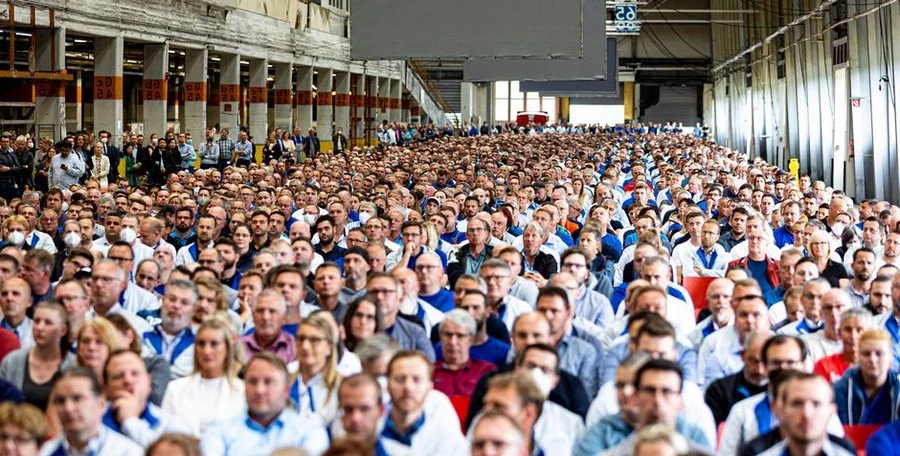
German automotive giant Volkswagen faces immense pressure to transform. The company plans extensive Volkswagen job cuts, potentially affecting up to 100,000 positions globally. This painful restructuring addresses a long-standing issue: its massive workforce has become a costly burden. The move is crucial for survival against agile Chinese electric vehicle (EV) competitors.
Volkswagen employs nearly 630,000 people. This figure rises to 680,000 with Chinese joint ventures. By contrast, Toyota operates with roughly 60% fewer workers. Ford, for example, has nearly 240% fewer staff. Once a symbol of German industrial power, this large headcount now represents a significant challenge.
Following previous reductions, Volkswagen is preparing to eliminate an additional 50,000 roles worldwide. This includes tens of thousands within Germany. The VW Supervisory Board officially backed this proposal on September 2. Furthermore, the plan impacts luxury brands like Porsche and Audi. Other German automakers, including Mercedes-Benz, are also planning staff reductions. Suppliers like Bosch have announced substantial cost-saving measures.
Much of Volkswagen’s workforce challenge stems from past strategic decisions. The company opted to control more production stages internally than its rivals. Analyst Meghan Ostertag noted that this in-house component and software manufacturing demanded a larger workforce. This approach significantly increased labor costs, which in Germany can be double those of competitors.
An aggressive acquisition strategy also contributed to the bloat. Over the years, this brought brands like Skoda, Porsche, and Bugatti into the VW Group. While successful, integrating these diverse brands created considerable operational complexities, explained automotive analyst Daniel Harrison.
Volkswagen also delayed its transition to electric vehicles. This occurred as Chinese EV makers rapidly gained technological leadership. Consequently, sales slowed in China, which accounts for a third of VW’s total sales. Demand also softened across Europe. This situation echoes an error by the US auto industry in the 1960s and 70s, which struggled to adapt to leaner competitors.
Toyota, by comparison, produces a similar volume of vehicles with nearly half the staff. Its efficiency comes from greater reliance on suppliers, higher automation, and simpler management structures. Analyst Matthias Schmidt further highlighted the strong influence of trade unions and a key shareholder. The German state of Lower Saxony, a 20% voting rights holder, can veto major decisions. It has previously resisted plant closures. Powerful German unions also secured high wages and benefits for VW staff, making them among the best-paid globally. This combined influence, Schmidt noted, led to “years of neglect in readjusting workforce numbers.”
Analysts question if Volkswagen’s turnaround plan is sufficient. Current proposals, including the additional 50,000 Volkswagen job cuts, offer short-term profitability. However, they argue the company’s fundamental cost structure and slow decision-making require deeper reforms. Ms. Ostertag suggests investing more heavily in automation. This would help compete with leaner firms like China’s BYD. VW has increased investments in robotics for EV production. It also plans its first sub-€20,000 EV next year.
China represents approximately 30% of VW’s global vehicle output. Mr. Harrison predicts further production shifts to Asia. He even foresees Volkswagen potentially sharing its European plants with Chinese EV producers, a previously “unthinkable” move. Policy efforts are also in motion. The German government offers subsidies for domestic EV battery plants. The European Union is advancing an Industrial Accelerator Act to protect strategic industries. However, EU tariffs on Chinese EVs are far lower than US levies. Historian Niall Ferguson warns Europe risks being flooded with Chinese cars. Economist Moritz Schularick provocatively suggested Volkswagen might “likely be bought by a Chinese car maker like BYD.”