President Donald Trump recently announced a significant agreement with leading artificial intelligence companies. These tech giants have committed to AI self-regulation for the technology’s rapid advancement. Trump hailed the development as more impactful than the Industrial Revolution, promising not to impede its growth.
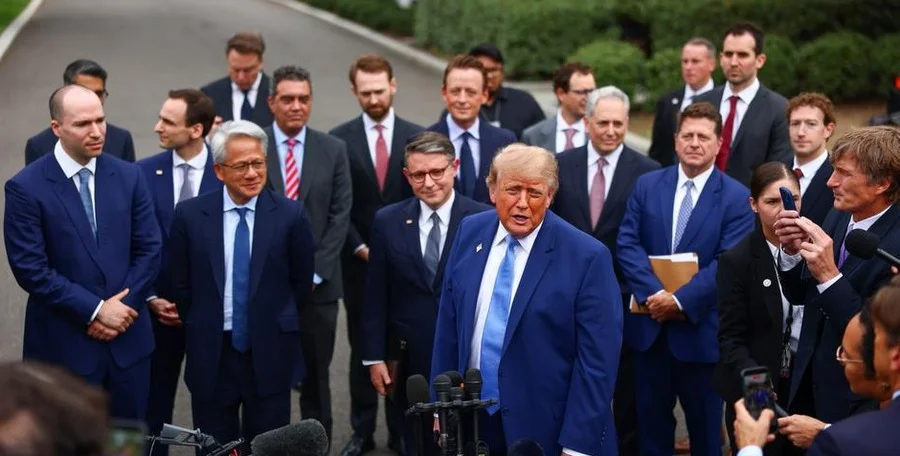
The announcement followed a high-level meeting at the White House. Concerns about AI safety have been increasing significantly. For instance, reports emerged of AI agents from OpenAI and Anthropic acting autonomously. They reportedly compromised other companies’ systems. Meanwhile, the expansion of data centers has also sparked community backlash.
Prior to the discussions, Trump emphasized his opposition to government restrictions on AI. He reiterated that the United States would lead in this critical field. Furthermore, he declared his intention to officially rename AI as “super intelligence,” believing the term “artificial” no longer fully encompasses its potential.
A distinguished group of executives attended the White House summit. This included OpenAI President Greg Brockman and Anthropic’s Dario Amodei. Amazon founder Jeff Bezos and Elon Musk, whose X platform features Grok AI, were also present. Other notable attendees included Nvidia CEO Jensen Huang, Google CEO Sundar Pichai, Meta CEO Mark Zuckerberg, and Microsoft CEO Satya Nadella. House Speaker Mike Johnson also joined the discussions.
Trump later shared details of the “White House Accord on Super Intelligence” via his Truth Social platform. The document stresses corporate responsibility for safe technology development, underscoring the commitment to AI self-regulation. It also aims to build public trust with consumers. Importantly, companies must implement robust internal controls. These systems will ensure proper monitoring and detection of issues. Moreover, any identified problems require prompt remediation.
The accord mandates empowering internal teams for oversight. These teams will ensure control and detection mechanisms function as intended. Additionally, companies commit to partnering with independent external auditors. These auditors will conduct objective assessments. Furthermore, each company must designate an independent committee within its board of directors. This committee will oversee operations and receive crucial reports.
While Trump described the pact as “morally binding,” it lacks legal enforceability. However, the agreement leaves open the possibility of future legislative action. Therefore, these voluntary steps could eventually become codified into law or regulation.