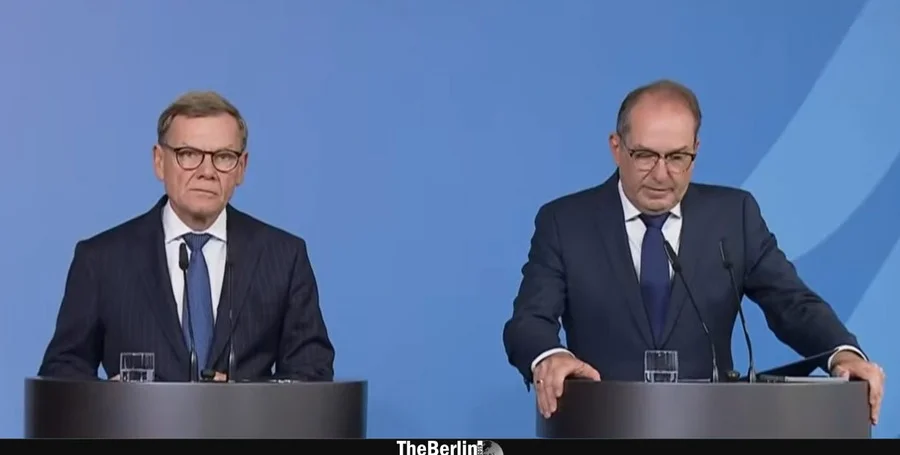
Germany has announced a robust package of German retaliation measures, targeting Moscow. This decision follows nearly a month of investigation into a failed drone attack at Leipzig/Halle Airport. Interior Minister Alexander Dobrindt (CSU) and Foreign Minister Johann Wadephul (CDU) delivered the news in Berlin, confirming Russia’s responsibility for the hybrid assault on August 4th.
The government’s response includes several firm actions. Russia’s general consulate in Bonn will close its doors on September 18th. Furthermore, the agreement for the Russian House in Berlin, long viewed as a cover for espionage, will be terminated. Authorities will also add more individuals to EU sanctions lists, imposing entry bans.
Additional security steps are also planned. Entry checks for Russian nationals will become stricter. Germany will increase pressure on Russia’s so-called shadow fleet, and further intelligence operations are anticipated. Foreign Minister Wadephul consequently summoned the Russian ambassador to communicate these decisions.
NATO Secretary General Mark Rutte has welcomed Germany’s planned response. He stated the evidence was clear, affirming the alliance’s full solidarity. Meanwhile, EU foreign policy chief Kaja Kallas highlighted Russia’s growing provocations across Europe, urging discussions on deterrence during an upcoming EU foreign ministers’ meeting in Ireland.
However, Russia’s Foreign Ministry spokeswoman Maria Zakharova swiftly condemned the moves. She called the German retaliation measures one-sided and unjust, promising a mirrored response. Zakharova also accused Germany of sponsoring terrorism by providing weapons and billions in aid to Ukraine.
The explosive-laden drone, equipped with a detonation mechanism, was discovered in a secure area of Leipzig/Halle Airport on August 4th. It lay among Ukrainian cargo planes. Federal prosecutors described the incident as a serious assault on German infrastructure. Interior Minister Dobrindt stated that the drone’s configuration, explosives, and detonation technology aligned with known Russian tradecraft, implicating low-level operatives.
Attorney General Jens Rommel previously noted Russia’s use of cheaply hired operatives for sabotage within Germany. These actions often aim to undermine German support for Ukraine. Chancellor Friedrich Merz (CDU) had also previously indicated a strong response was forthcoming.
Domestically, the attribution sparks debate, especially in eastern Germany. Concerns exist over skepticism toward Ukrainian support and fears of a NATO-Russia conflict. Right-wing parties like the AfD might exploit the findings, while mainstream parties may highlight the AfD’s ties to Russia. AfD leader Tino Chrupalla, for example, criticized the government for not reacting similarly to the Nord Stream 2 pipeline attack, which he attributed to Ukraine.
Minister Dobrindt cautioned Germans to prepare for more Russian hybrid actions, suggesting Moscow might seek to inflict greater damage. Nevertheless, Minister Wadephul asserted Germany’s unwavering commitment to its security policy. The nation remains steadfast in backing Ukraine and strengthening its own defenses.